What should an exchange publish so outsiders can keep checking assets, liabilities and delivery?
Binance’s Update #5, published at 12:45 UTC on 2 November 2026, says the full zero-knowledge proof for its 31 October 00:00 UTC snapshot is complete. Records of the page at 13:55 UTC and 14:31 UTC on 3 November show the same snapshot time, BTC block height 973895 and Merkle root, alongside eight ratios and four balance columns. This article has not obtained the proof file or personal leaf, or run the verifier. Binance requires a login to obtain account-specific data, but its verifier is public and runs locally. The documented login flow does not establish that every route to the full proof file requires an account.
An exchange should publish each proof with its version information and verification instructions so outsiders can repeat the checks. Complete liabilities, encumbrances and the ability to deliver withdrawals require further evidence. The checklist below distinguishes what each record can establish from what this article obtained for Binance’s snapshot. The limits of personal inclusion checks are covered in Exchanges say the assets are back. What can users actually verify?.
What Binance published for this round
Recovery Update #3 (CMS, 31 October 2026) said coverage was then about 90%, that BTC, ETH, USDT, BNB, SOL, USDC, XRP, USD1, RLUSD and ZEC were 100% backed, and that the replenishment drew on part of SAFU, part of the futures insurance fund and Binance’s corporate treasury. It said the SAFU fund is held by Nest Clearing and Custody Limited, a recognised clearing house regulated by the ADGM FSRA. It also said the 31 October snapshot was already on the PoR site, with the full proof estimated by 3 November UTC. The 90% figure belongs to that notice.
Recovery Update #5 (CMS, 12:45 UTC on 2 November) says the full zk proof for that snapshot was completed within the estimated time. The ten tokens are BTC, ETH, USDT, BNB, SOL, USDC, XRP, USD1, RLUSD and ZEC, and the notice says holders can check that their balances are backed at a minimum of 1:1. The same notice says Binance has covered approximately 95% of the impacted amount, that the outstanding 5% is tokens outside that top ten and less liquid, and that another snapshot covering more tokens is planned for 4 November, with a further proof estimated at about 40 to 50 hours. The self-check is described as logging in and downloading the verifier from the PoR site onto one’s own computer. The audit link in the notice points at Hacken’s February 2023 code review, which is not a report on this snapshot. The 95% figure stays with Update #5. It does not rewrite the 90% in Update #3.
The recorded readings of the English PoR page at 13:55 UTC and 14:31 UTC on 3 November show Audit Time 31/10/26 00:00:00 UTC, BTC block height 973895, zk-SNARKs, and Merkle root 169dd7e2300fabd4f7a8d11d745fe24f4c31ae1ccac6c4391fbd47b548740ad0. The eight rows below reproduce those readings; balances are in units of each token, not dollars. A direct request at the time returned HTTP 202 with an empty body. The rendered text included carousel markers 1 and 2 but no RLUSD or ZEC figures. Those ratios were not obtained.
| Token | Ratio | Net Account Balances | Onchain Wallet Balance | Exchange Balance | Third-Party Custody |
|---|---|---|---|---|---|
| BTC | 100.04% | 692,186.737 | 692,488.864 | 681,664.711 | 10,824.153 |
| ETH | 100.00% | 3,654,919.15 | 3,654,921.842 | 3,593,536.483 | 61,385.359 |
| USDT | 100.00% | 29,483,062,742.4 | 29,483,062,748.463 | 29,169,862,909.63 | 313,199,838.833 |
| BNB | 101.30% | 42,638,275.565 | 43,192,045.152 | 42,665,644.408 | 526,400.744 |
| SOL | 100.00% | 24,636,959.409 | 24,636,962.108 | 24,249,696.437 | 387,265.671 |
| USDC | 106.08% | 6,150,945,132.288 | 6,525,162,638.928 | 6,494,873,196.615 | 30,289,442.313 |
| XRP | 100.99% | 2,516,373,182.286 | 2,541,393,612.546 | 2,458,677,298.071 | 82,716,314.475 |
| USD1 | 100.04% | 2,438,555,978.253 | 2,439,495,268.943 | 2,428,881,714.513 | 10,613,554.43 |
The page defines Proof of Reserves as assets held in custody for users. Its three stated zk-SNARK constraints cover inclusion of account balances in the total, a non-negative account net balance, and a valid Merkle root change after a leaf update. It also claims zero debt in Binance’s capital structure; an earlier reading records a statement that excess assets in PoR addresses do not represent all of Binance’s own assets. This article has no independent report substantiating those claims. The name Proof of Reserves does not establish which checks satisfy the definition of proof of solvency discussed below.
Staff replies are separate from the numbered updates. At 12:27 UTC on 3 November, Diana repeated the 4 November snapshot plan and the following 40 to 50 hours, and said there was no update to share on open-sourcing the circuit. She did not identify a version. A circuit directory is already public, and Binance’s 10 February 2023 post describes its earlier zk-SNARK launch, so the reply does not identify which version might remain unpublished. CZ’s original post was on 2 November; Diana’s replies between 12:28 and 12:42 UTC on 3 November reiterated that 100% of the required funds had been allocated from Binance’s own balance sheet, without borrowing, selling assets or raising capital. She described the 7,499 BTC transfer as part of SAFU’s deployment and distinguished replenishment from recovery of stolen funds. These remain company-side claims. Allocating funds does not establish that every affected token has been acquired. Her 12:24 UTC reply discusses phased security checks for HYPE without announcing that its withdrawals have reopened.
What can be checked without logging in
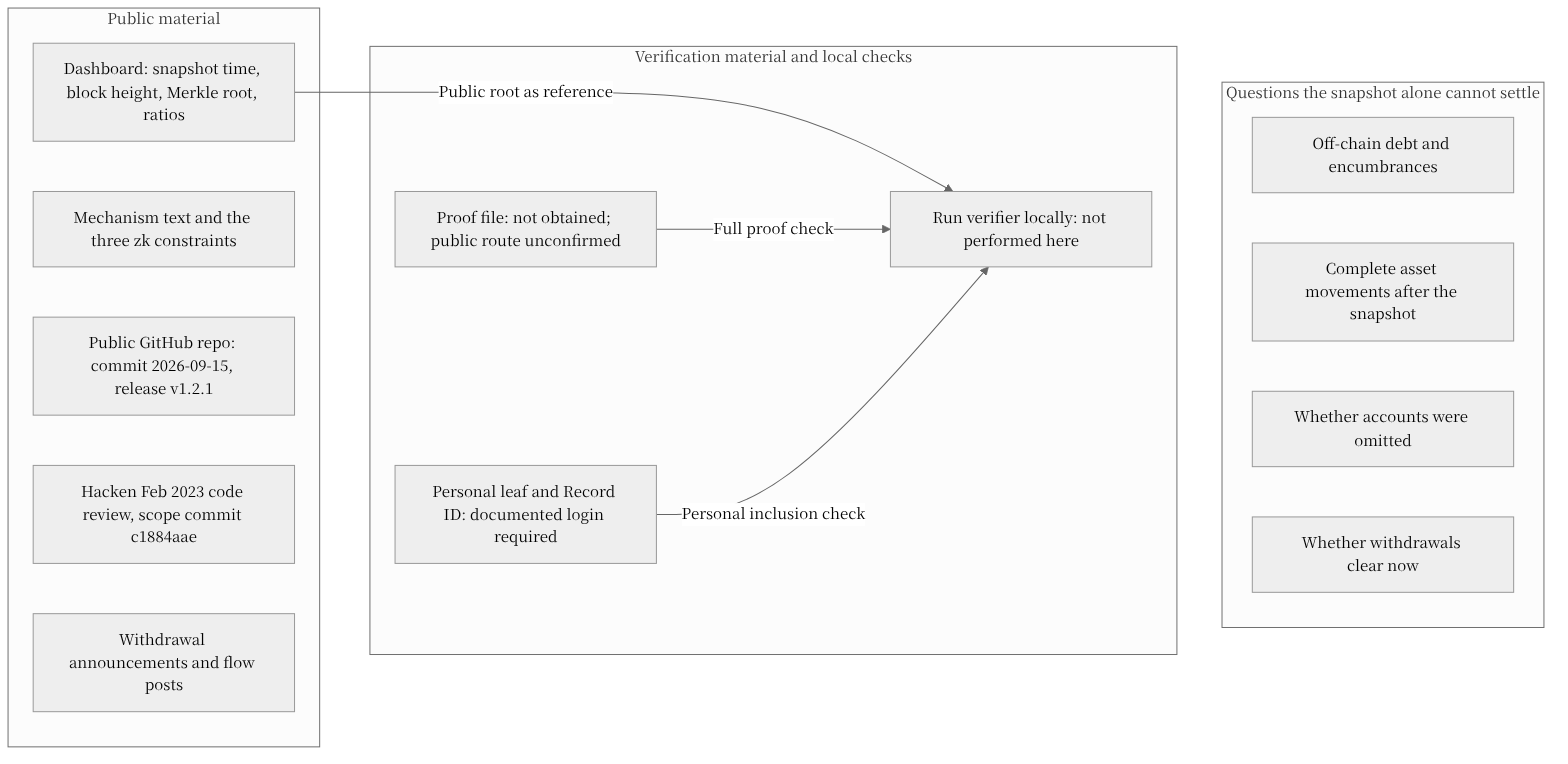
Public material includes the dashboard and mechanism text, the GitHub repository, Hacken’s review dated 14 February 2023, and withdrawal and flow posts. The latest commit is a7addd932672, dated 15 September 2026. Release v1.2.1 was published on 29 July 2026; its notes raise AssetCounts from 500 to 700 and add a third asset tier. The repository has a circuit directory, and the README points to circuit/batch_create_user_circuit_test.go. Neither the README nor the release notes lists the snapshots produced with each build.
Recalculating with decimal arithmetic gives a difference of 0 between Onchain Wallet Balance and the sum of Exchange Balance and Third-Party Custody on all eight rows. Dividing Onchain Wallet Balance by Net Account Balances also reproduces each percentage when rounded to two decimal places. This checks the arithmetic within the published figures, not the underlying balances.
The page has buttons labelled “Download All Address” and “View Report”. Both readings returned the labels and no destination. The address list and the report were not obtained.
The official instructions distinguish obtaining account data from running a local check. Update #5 requires users to log in for self-verification, but also says anyone can download and run the verifier. Wallet then Verification provides the personal Merkle leaf and Record ID. The recorded binance.info FAQ is marked updated on 2 November 2026 at 09:05, with no time zone; this review also retrieved the same article on Binance’s main site. It names config.json, proof.csv and zkpor864.vk.save as inputs, user_config.json for personal data, AccountIdHash as the Record ID, and Asset_List.csv. Its version table assigns verifier 1.2.1 to the cycle “2026-08-01 to Current”, which includes 31 October. That is a version guide, although the actual proof package is still needed to check its proof, verification key and circuit correspondence. The filename zkpor864.vk.save alone establishes neither compatibility nor a mismatch. No package was obtained and no verifier was run for this article.
Hacken’s report is dated 14 February 2023 and covers commit c1884aae22cd17af023ac4424b4e6623eb0ea9dd. It identifies one critical issue allowing the total debt amount to be falsified, later marked fixed. Its warning about proofs generated before the fix is that they may appear valid without any guarantee that the vulnerability was not used to alter them. That does not mean the verifier necessarily rejects them. Finding ids beginning F-2024 do not change the report’s 2023 date. “Potential omission of users” is listed as Low and accepted; its collapsed description was not obtained. The review does not cover the 29 July 2026 release or current HEAD a7addd932672. The build that produced the 31 October proof still needs to be matched to the actual package.
The checks reproduced here are the arithmetic on the page and inspection of the public code documentation and earlier review. Checking this round’s proof still requires its files. A successful proof check would not, by itself, establish that the source ledger is complete or that the assets are unencumbered.
Liabilities, assets and solvency each need their own material
Vitalik Buterin’s article of 19 November 2022 calls a demonstration of total customer deposits a proof of liabilities, and control of the keys to a corresponding quantity of coins a proof of assets. Together they form his definition of proof of solvency. arXiv:2603.12990 similarly groups steps 1 and 2 as PoL and step 3 as proof of assets, which can use an auditor’s sign-off, published addresses or zero-knowledge techniques. The preprint describes Binance’s existing design as general-purpose SNARKs with a standard Merkle tree. It does not inspect the 31 October 2026 proof file.
On Binance’s page, the three constraints apply to the accounts that were put into the proof: inclusion in the total, a non-negative net balance, and a valid root after a leaf update. That is the liability side. On the asset side, the page says wallet ownership is part of the process. The address-list button was not opened.
The previous post covers how personal inclusion checks can miss omitted accounts. Provisions requires customers to check their own inclusion; arXiv:2603.12990 also studies an off-the-books attack involving collusion to understate a user’s published balance. Neither establishes that Binance omitted accounts in this incident.
The PoL discussed here checks customer balances submitted to a commitment. It cannot by itself establish the company’s other debts or whether its assets are borrowed or pledged. The PCAOB Office of the Investor Advocate’s staff note of 8 March 2023 warns that PoR procedures are likely not to cover liabilities, holders’ rights and obligations, or borrowing used to make reserves appear sufficient. Checking Binance’s zero-debt claim would require company records and external evidence. This article has no bank confirmation, schedule of contractual encumbrances or independent report addressing that claim.
A proof is a point in time
Provisions notes that a solvency proof cannot guarantee future conditions: an exchange may subsequently be hacked or remove customer funds. The PCAOB staff note likewise says a point-in-time report gives no assurance that assets remain available after it is issued.
Binance’s snapshot is dated 00:00 UTC on 31 October, and Update #5 was published on 2 November. In between, its post at 16:12 UTC on 1 November says it processed US$4.649 billion of withdrawals between 06:00 and 15:30 UTC that day. The 31 October snapshot cannot reflect those later transactions. The proposed 4 November snapshot would provide another point-in-time state, not a complete record of the intervening flows.
Published addresses and evidence of control would let outsiders monitor the listed addresses’ on-chain balances and transactions between proofs. That would still leave the internal ledger unseen. This article did not obtain the contents of “Download All Address”.
The NYDFS letter of 23 January 2023 provides a historical example of the records expected for separating customer and corporate assets. It called for the custodians within its scope to segregate them both on-chain and on internal ledgers. The same day’s press release expressed an expectation that custody would not thereby establish a debtor-creditor relationship. That guidance was superseded on 30 September 2025. The replacement text was not obtained for this article; the old text is used only as a historical comparison, not to assess Binance’s snapshot or current legal obligations.
Delivery depends on the withdrawal list and the flows
The snapshot ratio compares assets with account balances at a particular time. Whether a withdrawal clears now requires information about the selected asset and network and the actual processing result. No withdrawal was tested for this article.
Recovery Update #6 says withdrawals for the assets below would reopen from 04:00 UTC on 3 November, not all at once, that deposits stay open, and that Binance will bear the loss. The X post is timed 02:30 UTC. The asset table follows the CMS text.
| Network | Assets named in that notice |
|---|---|
| BSC | USD1, XUSD, U, ADA, FDUSD, LTC, BTC, ETH, XRP, NEAR, ZEC, WBETH, DOGE, CAKE, SOL, FET, DOT, LINK, SHIB, XLM, ALT, BMT, EDU, HBAR, BANANAS31, BONK, HUMA, PARTI, IOST, LISTA, TUSD. The notice also says withdrawals for all bSTOCKS will be opened |
| ETH | RLUSD, USD1, ENA, USDE, PENDLE, WLD, FDUSD, XUSD, QNT, SHIB, ZRO, FET, NIL, ONDO, ALT, SKY, LINK, ETHFI, REZ, JASMY, PUNDIX, BTC, BAT, STRK, POL, ANIME, LSK, RE, BREV, RLC, AMP, PLUME, BLUR, WBETH, ZBT, ENSO, AVA, TUSD |
| SOL | USD1, PUMP, FDUSD, BMT, RENDER, RAY, TRUMP, MET, PENGU, JUP, PYTH, BONK, KMNO, BNSOL, ORCA, WIF, W, HUMA, JTO, IO, 2Z, BOME |
| XRP | RLUSD |
| SUI | USDC, HAEDAL |
| Arbitrum | CHIP, ANIME |
| Optimism | OP, WCT |
| TRX | TUSD |
| Base | ZEN, MIRA, HOME, AWE |
For this second-phase plan, the restoration posts reviewed name ETH and SOL. The 04:08 UTC post lists RLUSD, USD1, TUSD, FDUSD and XUSD on ETH. The 07:08 UTC post adds an ETH batch and the SOL list, with the earlier five ETH assets marked Already Enabled. TUSD appears under both New and Already Enabled. The combined ETH set matches the CMS ETH row, as does the SOL list. The two posts do not name the plan’s BSC, XRP, SUI, Arbitrum, Optimism, TRX or Base additions. A from:binance search around 14:31 UTC on 3 November found no matching restoration post after 07:09 UTC. Searches can miss posts, so this does not establish that every asset on those networks remained unavailable.
The flow figures are company statistics: US$4.649 billion withdrawn, US$1.01 billion deposited and approximately US$3.64 billion in net outflows between 06:00 and 15:30 UTC on 1 November. Binance describes the net outflow as 2.1% of US$171 billion in AUM, based on PoR data as of 28 October. This article neither independently reconciles those figures nor combines that denominator with the 31 October snapshot.
An announcement establishes the scope the company announced. A status page can show current availability labels but cannot guarantee that a particular withdrawal completes. The status page obtained for the previous post had no coin rows; current status was not checked again here.
What an exchange should publish
The table uses the records gathered at 13:55 UTC on 3 November and the follow-up readings at 14:31 UTC. “External check” describes what could be checked if the material were published. The Binance column records what was obtained: Published means the material was read, not independently validated; Company says so; not obtained preserves a company claim; Not obtained covers material not downloaded or not located. Even None in the sources read cannot establish that no such document exists.
| Record | What it supports | Limits | External check | Binance, 31 October 2026 | Source |
|---|---|---|---|---|---|
| Snapshot time and block height | Identify the stated time and block | The state of assets afterwards | Read the time; check the block separately | Published (31/10/26 00:00 UTC, 973895) | F04, B01 |
| Liability commitment (Merkle root) | Provide a commitment against which proofs can be checked | Whether all accounts and correct balances were committed | Readable; the root alone is insufficient | Published | F04, B03 |
| Per-token ratios and four balance columns | Check arithmetic within the published figures | Underlying accuracy or tokens outside the scope | Recalculate | Eight rows published; RLUSD and ZEC not obtained | F04 |
| On-chain addresses and control signatures | Check listed balances and control demonstrated by signatures | Borrowing, pledges or customer entitlement | Checkable if the material is public | Address list and signatures not obtained; only a download label was read | F06, F16, F17, B03 |
| Full proof file and verification inputs | Repeat checks with the matching verifier, key and public commitment | Liabilities outside the proof or completeness of the source ledger | Local verification if the files are available | Company says so; not obtained; a public download route is unconfirmed | F01, F06, F17 |
| Verifier source and version mapping | Identify the documented verification version | Correctness or correspondence with the downloaded package | Read code and version instructions | Repository published; FAQ assigns 1.2.1 to 2026-08-01 to Current; this round’s package not obtained | F07; FAQ |
| Circuit source and version mapping | Inspect constraints and their correspondence with this proof | Completeness of the source ledger | Read public code; matching it to this round needs more data | Circuit directory published; correspondence with this round not obtained | F05, F07, F12, F15 |
| Independent code review and scope | Identify the reviewed build, procedures and findings | Other builds or this snapshot’s correctness | Read the report | Published; scope is the commit in the 14 February 2023 report | F08 |
| Personal inclusion (leaf, Record ID) | Check one’s balance using the path and public commitment | Complete inclusion of other accounts | Documented login to obtain personal data; local verification | Company says so; not obtained | F02, F05, F16, F17, B01 |
| Independent report on off-chain debt and encumbrances | Check liabilities and asset restrictions within its scope | Matters outside scope and subsequent changes | Read a public report; substantive checks need further evidence | Not obtained; zero debt remains a company claim | F05, B04 |
| On-chain and internal records separating customer and corporate assets | Check how the company classifies and accounts for them | Legal entitlement from address labels alone | On-chain records are public; internal books need further evidence | Complete reconciliation not obtained | F05, F18 |
| Third-party custody amounts, shares and custodians | Identify reported amounts and who holds them | Custodian finances and asset restrictions | Read disclosures; seek corroboration from custodians | Amounts published; corresponding custodian details not obtained | F04, F14 |
| Accountant’s report, engagement type and scope | Identify procedures, findings and any assurance offered | Matters outside scope; agreed-upon procedures offer no opinion or assurance | Read the report according to its engagement type | Not obtained; the View Report destination was not checked | F16, B04, B05 |
| Withdrawal list (asset by network) and time | Identify the scope and time announced | Whether a particular withdrawal completes | Read announcements; check results separately | Published: Update #6 plan; ETH and SOL restoration posts at 04:08 and 07:08 UTC | F09, F10 |
| Withdrawal flows and denominator date | Identify reported flows and their calculation basis | Accuracy, completeness or later withdrawal success | Read and recalculate; full reconciliation needs underlying records | Published (1 November; denominator is 28 October AUM) | F11 |
| Next snapshot date and excluded tokens | Identify planned timing and coverage | Whether the plan will be completed | Read the announcement | Date published (4 November); Update #5 gives no itemised list of excluded tokens | F03 |
Update #3’s statement about SAFU’s custodian does not identify the custodians behind the customer-asset Third-Party Custody column. That correspondence was not obtained, and the ADGM register was not rechecked. Internal ledgers and encumbrances generally require evidence from others; the scope of any resulting report still matters.
This is a disclosure checklist, not a regulatory standard or a conclusion about Binance’s solvency.
Where the same rows show up elsewhere
Kraken and OKX illustrate different ways of making these records available.
Kraken’s page uses a snapshot date of 30 June 2026. It says an independent third-party accountant aggregates an anonymised snapshot into a Merkle tree and collects Kraken’s signatures over the on-chain addresses. The ratio strip includes ADA and USDG. The scope sentence lists BTC, ETH, SOL, USDC, USDT and XRP. The two lists disagree, and both are left as printed. Account-specific data sits inside the account, on a Proof of Reserves tab. The main page does not name the firm. The widget it links, read at 14:31 UTC on 3 November, shows Attestation Provider as The Network Firm LLP, against a snapshot labelled 06/30/2026 11:59 PM UTC and BTC block height 956140. Download Report is a button. No PDF URL was in the page, and the report was not opened. These pages describe an accountant’s involvement and address signatures; the report itself is needed to establish the engagement type and scope.
OKX describes a 49th report in November 2026. It says the liability file is a downloadable zk-STARK archive which unzips to sum_proof_data.json, that a personal inclusion check still goes through PoR reports after login, and that addresses carry the signed message “I am an OKX address”. The disclaimer says the report is a snapshot at the time of capture, and that tokens outside the scope, and transactions after the snapshot, are not included. The page states 21 assets and, later, 22 coins. The download page was recorded at 14:31 UTC as listing a direct link to a 1 November 2026 liability zip, with no login form encountered when obtaining the link. A HEAD request to that URL returned HTTP 200, last-modified 05:49:21 GMT on 2 November 2026. The file was not downloaded, so sum_proof_data.json itself was not seen. This illustrates a public download route, without establishing the file’s contents or a successful verification.
An agreed-upon procedures report must be distinguished from other accountants’ reports. Under ISRS 4400 (Revised), the practitioner and engaging party agree the procedures, and the practitioner reports the factual results without an opinion or assurance conclusion. That restriction applies to agreed-upon procedures; it cannot be extended to every accountant’s report. The PCAOB Office of the Investor Advocate’s note says PoR engagements are not audits, but is a staff view rather than a Board rule, policy or statement. Kraken’s report PDF was not obtained, so the widget’s Attestation Provider label is insufficient to classify its engagement.
The FSRA statement of 30 October 2026 says the regulator is aware of the unauthorised withdrawals at Binance that day and is engaging with Binance and monitoring the incident. The statement offers neither an investigation conclusion nor an opinion on solvency.
Whether frozen funds have been returned, and the outcome of Arbitrum’s governance discussions, still require primary records.
Still unclear
- Whether outsiders can repeat the full zk proof check. Update #5 says it is complete, but no proof file was obtained or verifier run here. A public download route remains unconfirmed.
- The RLUSD and ZEC ratios and balances. Update #5 names ten tokens, but the recorded page readings contain eight rows; the missing figures cannot be inferred.
- The planned 4 November snapshot and proof estimated 40 to 50 hours later. At 14:31 UTC the record still showed 31 October, before the announced next snapshot date. The searches did not locate Update #7.
- Whether the second-phase additions on the seven networks omitted from the two restoration posts have opened. The ETH and SOL additions announced as restored were not tested either.
- How the approximately 95% replenishment claim relates to “100% allocated” funding. Itemised quantities, purchases and uses of funds are still needed; the two statements cannot be combined into a completion ratio.
- Whether frozen funds have been returned. No issuer notice was obtained; OFAC recent actions and Optimism’s official page were not reopened. The flow post at 05:51 UTC on 3 November was not rechecked either.
- Zero debt is a claim on Binance’s PoR page; no borrowing to fund replenishment is Diana’s claim. Evidence establishing pledges, rehypothecation or other encumbrances, and a corresponding independent report, was not obtained.
- Hacken’s 2023 review covers commit
c1884aae, not current HEADa7addd932672. The FAQ’s 1.2.1 date range includes this snapshot, but correspondence between the proof, verification key and actual circuit remains unconfirmed. - The Mazars engagement of December 2022 and its end: the Reuters text and report PDF were not obtained. Nor were verifiable custody figures from a Coinbase filing, VARA or ADGM COBS rules, the Japanese Payment Services Act or an FSA cold-wallet ratio, the NYDFS text of 30 September 2025, or an AICPA guide devoted to PoR.
- Arbitrum’s emergency-action thread and the outcome of the 3 November call were not obtained. The agenda scheduled 16:00 to 17:00 UTC, after the research cut-off. Its on-chain AIP list contained no proposal to release frozen funds; that says nothing about decisions through other procedures.
- Update #5, Update #6 and the replies reviewed do not explain the root cause, how any EIP-7702 authorisation was obtained, or further intrusion points.
This article organises public material and is not financial advice. A later post in the series will examine the full incident postmortem once a root-cause report from the company or a retained forensic firm allows the intrusion and authorisation failures to be checked.
Notes
- Published figures can be checked for arithmetic consistency without establishing their accuracy. This article did not obtain this round’s proof file or run the verifier.
- The documented flow requires a login for personal data; the verifier is public and runs locally. A public route to the full proof file remains unconfirmed.
- A customer-balance proof cannot by itself establish other corporate liabilities or asset restrictions. The zero-debt claim needs external evidence.
- A new snapshot on 4 November would not replace a complete record of the intervening flows.
- The second-phase restoration posts reviewed name ETH and SOL additions, with no withdrawals tested here. Missing posts do not establish that an entire network remains closed.
- “Not obtained” describes the limits of the research. Approximately 95% replenished and “100% allocated” funding remain separate claims.
Further reading
- Security Incident | Recovery Update #5 (CMS, 12:45 UTC on 2 November 2026): the company’s notice, source for the completed proof, the ten tokens, approximately 95%, the 4 November snapshot and the logged-in self-check. The audit link points at the 2023 code review.
- Security Incident | Recovery Update #6 (X, 02:30 UTC on 3 November 2026) and the CMS page: the company’s notice, source for the nine-network plan. The asset table follows the CMS text.
- Security Incident | Recovery Update #3 (CMS, 31 October 2026): the company’s notice, source for the snapshot arrangements, the approximately 90% figure at that time, and Nest Clearing and Custody Limited as holder of SAFU.
- Post at 04:08 UTC and post at 07:08 UTC: the company’s lists of ETH and SOL assets announced as restored. No withdrawal was tested.
- Post at 16:12 UTC on 1 November 2026: the company’s flow figures and the 28 October AUM denominator. Not independently reconciled.
- @dianabinance, 12:24 to 12:42 UTC on 3 November 2026 (including 12:24, 12:28, 12:30, 12:42, and the quoted CZ post of 16:58 UTC on 2 November): staff replies, not a numbered update. Source for the circuit sentence, the 100% allocation and the split between replenishment and recovery.
- Binance Proof of Reserves (read at 13:55 UTC and 14:31 UTC on 3 November 2026): the company’s mechanism text and dashboard, source for the 31 October figures. The proof-file and address-list buttons were not followed. A direct request returned HTTP 202 with an empty body.
- How to Verify Your Account Balance on Binance?: the FAQ as served on binance.info, marked updated on 2 November 2026 at 09:05. Source for the verifier’s input filenames and the 1.2.1 cycle. The same article was retrieved on the main site during this review; no proof package or execution output was obtained.
- binance/zkmerkle-proof-of-solvency and v1.2.1: the public verifier repository. Source for the commit, the release date and the v1.2.1 notes. No release note maps itself to this snapshot.
- Hacken: [PoR] Binance | PoR Code Audit | Feb2023: a third-party code review scoped to the commit of 14 February 2023. Finding ids begin with F-2024; the report date is 2023. Not a review of this snapshot. The body of “Potential omission of users” was not expanded.
- Binance Square, 10 February 2023: the company’s account of the November 2022 Merkle PoR and the zk-SNARK addition after it. The Mazars episode was not obtained.
- Kraken Proof of Reserves (snapshot 30 June 2026) and the LedgerLens widget: another exchange’s pages. The accountant’s Merkle and address-signature process is on the main page; the attestation provider’s name is on the widget. The report PDF was not opened.
- OKX Proof of Reserves (November 2026, the 49th report) and the download page: another exchange’s pages. Source for the downloadable liability file and the address-signature message. The zip was requested with HEAD only and was not downloaded.
- NYDFS guidance of 23 January 2023 and the press release of the same day: a supervisor’s expectation for licensed custodians. The page says the guidance was superseded on 30 September 2025; that later text was not obtained. The press release of 30 September 2025 is used only for the supersession sentence.
- ADGM FSRA statement of 30 October 2026: a supervisor’s statement that it knows of the incident and is monitoring it, with no conclusion.
- PCAOB Investor Advisory (8 March 2023): staff of the Office of the Investor Advocate, not a Board rule. Source for “PoR engagements are not audits”.
- ISRS 4400 (Revised) (IAASB, April 2020, IFAC PDF): the international standard. Source for agreed-upon procedures being neither an audit nor an opinion. Paragraphs 4 and 6 were checked during this review; the full standard was not reviewed page by page.
- Provisions (Dagher and others, ACM CCS 2015 / ePrint 2015/1008): the academic paper. Source for “no proof of solvency is future proof” and for customers checking their own inclusion.
- Having a safe CEX (Vitalik Buterin, 19 November 2022): a personal technical article. Source for the three terms.
- Mitigating Collusion in Proofs of Liabilities (Mohamed and Karame, arXiv:2603.12990, 13 March 2026): a preprint. Source for the split between PoL and proof of assets, the off-the-books case, and the description of Binance’s design. Not an inspection of this round’s proof file.
- Arbitrum governance call agenda, 3 November: a governance forum page. It had no conclusion when opened.
Ideas and technical judgement by Sheng; drafted with Claude · topic chosen by Sheng; text, case notes and the checklist written by Claude. This post has no code examples.