Who can press the stop button? Freezes, chain halts and hard forks act at different layers
An exchange can pause withdrawals, an issuer can block an address, and validators can refuse transactions. All may be called a “freeze”, although they affect different assets and require different steps to undo. Starting with Binance in October 2026, this post compares six ways to intervene, from exchange controls and L2 governance to law-enforcement requests. The DAO in 2016, BNB Chain in 2022 and Sui in 2025 show where those powers overlap and where they stop.
Tether, Circle, Ripple, Arbitrum and the analytics firms published figures at different times and on different bases. Keep those figures separate. Adding them would risk counting the same funds more than once.
Binance 2026: who froze what, and when
The table records public statements checked on 2 November 2026. Each figure retains its source’s timestamp. Personal posts, organisation statements and analytics estimates are listed separately rather than combined into a total.
| Party | Statement | Time (UTC unless stated otherwise) | Source type |
|---|---|---|---|
| Circle (Jeremy Allaire, personal X) | more than 800M USDC frozen in coordination with law enforcement | 2026-10-29 21:18 | issuer executive, personal post |
| Tether (Paolo Ardoino, personal X) | more than 1.567B USDT frozen | 2026-10-29 21:25 | issuer executive, personal post |
| Ripple (Jack McDonald, personal X) | actively freezing affected RLUSD, no amount | 2026-10-29 22:08 | issuer executive, personal post |
| WLFI (organisation account) | worked with BitGo to freeze stolen WLFI and USD1, no amount | 2026-10-29 22:17 | issuer organisation post |
| Zach Witkoff (personal X) | said steps had been taken to freeze US$27 million in USD1 | 2026-10-29 22:15 | personal post; kept apart from the organisation post and from TRM |
| Paxos (organisation account) | 1,906.67 PAXG frozen in a named wallet, no dollar figure | 2026-10-29 22:56 | issuer organisation post |
| First Digital Labs (organisation account) | said steps had been taken to freeze FDUSD linked to the incident, no amount | 2026-10-30 00:57 | issuer organisation post; the CEO’s personal account quoted it later, still without an amount |
| Arbitrum (official X) | Security Council emergency action to rescue 74,559,805 ARB and 8,425 ETH, moved to an intermediary frozen wallet; movable only by further Security Council action or an Arbitrum DAO vote | 2026-10-30 00:19 | L2 official account |
| Arbitrum (governance forum) | wording is freeze; 74,559,805.2 ARB and 8,425 ETH; time given as 8:08am HKT; funds movable only by an ArbitrumDAO governance vote | forum page time carries no zone | L2 official forum, cited separately from X |
| TRM | about US$2.67 billion in stablecoins, roughly US$2.7 billion with Arbitrum; Tether about 1.77 billion USDT, Circle about 825 million USDC, Ripple 40.5 million RLUSD, WLFI 27.8 million USD1 | as of 2026-10-30 00:30 | analytics firm, on-chain count |
| Chainalysis | funds began leaving around 4:20 p.m. Eastern on 29 October; freezes started by 5:14 p.m. Eastern; the summary still leaves the total’s time field unfilled | Eastern Time | analytics firm |
| Elliptic | US$2.85 billion of frozen or seized funds verified, 44% of the theft, almost all USDT and USDC; article marked as its final update | 2026-11-01 about 05:50; header 08:00 | analytics firm, verification |
| Elliptic, naming others | Ripple, WLFI, Paxos and First Digital froze further stablecoins; Tether froze tokenised gold; Binance froze its own WBETH; no amounts | no per-issuer time in the text | analytics firm; issuers’ own posts are the rows above |
- Ardoino’s 1.567 billion and TRM’s roughly 1.77 billion come from different moments; Ardoino’s post does not explain a full counting method. Neither source establishes that its figure updates the other.
- A post’s timestamp is not the time a freeze began. Chainalysis gives 4:20 p.m. for the outflow and 5:14 p.m. for the first freezes, TRM says most of the movement happened in about 20 minutes from 20:05 UTC, and Allaire’s post is stamped 21:18 UTC. This post does not merge them into one “response time”.
- Binance’s own figure of about US$3 billion frozen in its update of 30 October 2026, and the withdrawal pause and phased resumption, are covered in Exchanges say the assets are back. What can users actually verify? and are not repeated here.
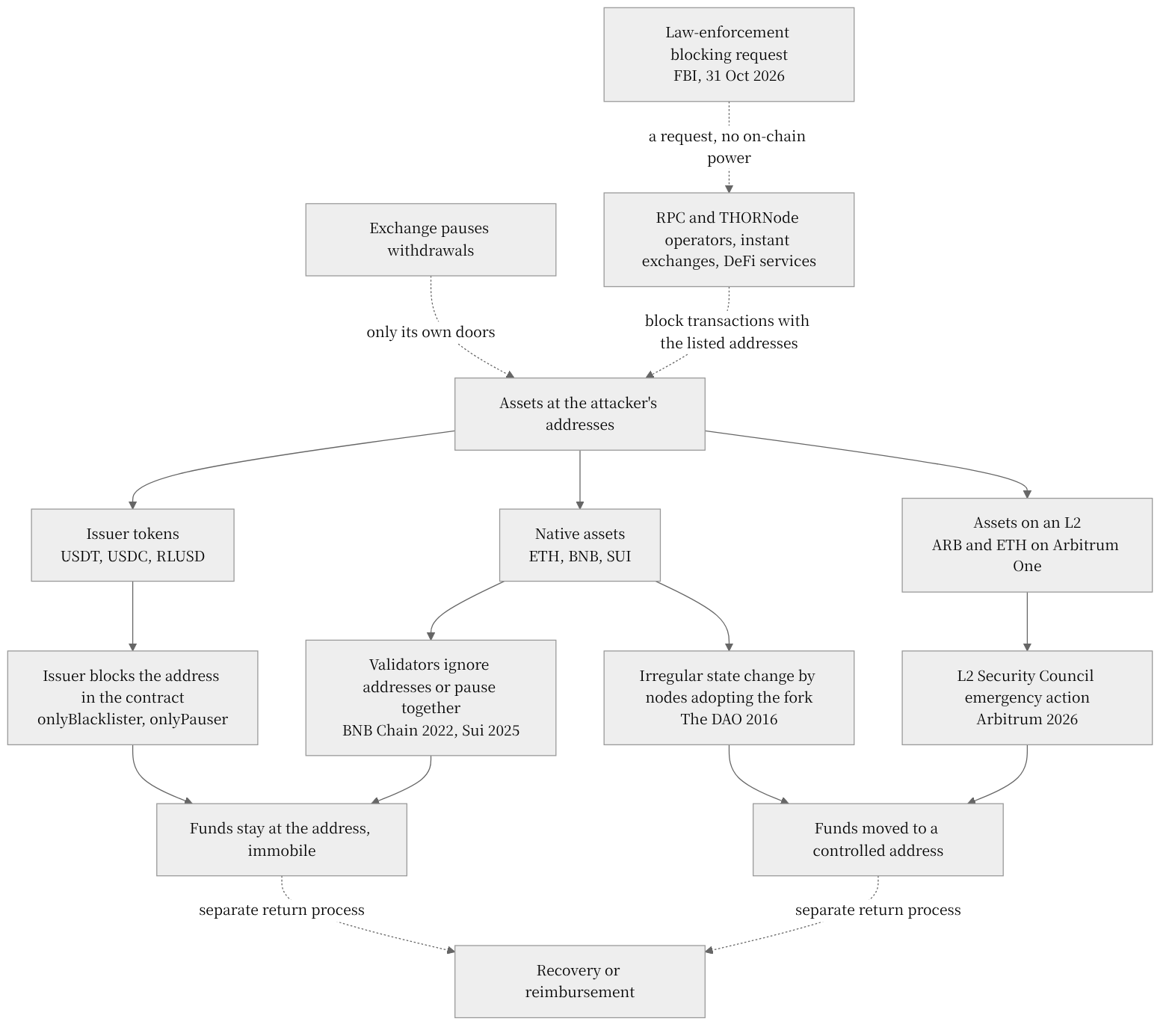
The diagram groups the actions by who can authorise them and shows whether funds stay at the original address or move elsewhere.
Layer one: the exchange pauses withdrawals
An exchange can stop accepting or sending withdrawal requests. That service pause does not itself alter completed on-chain transactions or recover assets that have already left. Further intervention needs someone with power over those assets.
Ronin’s announcement of 29 March 2022 says the bridge and Katana DEX had been halted. Its Q&A also says users could neither deposit nor withdraw funds. This covered a bridge and a DEX; describing it simply as an exchange withdrawal pause would miss that scope.
Layer two: the issuer blocks an address in the contract
Issuers mint and redeem fiat-backed stablecoins and may retain administrative controls in the token contract. USDC has both address blocking and a pause mechanism. Its modifiers check permissions or contract state before allowing an operation.
In Circle’s public source (circlefin/stablecoin-evm), the transfer path in FiatTokenV2_2 carries the whenNotPaused and notBlacklisted checks, blacklist is restricted by onlyBlacklister, and pause by onlyPauser. This is a source-code check, without a comparison against deployed bytecode. Blocking stops transfers to and from an address; the blocking function does not destroy its balance. Pausing applies across operations guarded by the pause check, rather than to a single address. Neither action stops the underlying chain from producing blocks.
Circle’s blog of 10 April 2026 says that when Circle freezes USDC it is because the law requires it to act.
A court filing contains another version of Circle’s Stablecoin Access Denial Policy (Case 5:26-cv-05055-PCP, Document 2-8, Exhibit F, filed 28 May 2026). It limits address blocking to the exceptions in Part 3, which lists two grounds: a threat to the stablecoin network, assessed at Circle’s discretion, or compliance with applicable law, regulation or an order from an authority with jurisdiction over Circle. The first gives compromised privileged keys and unauthorised issuance as an example; the second names US and French authorities and courts, as well as other government authorities with jurisdiction.
In that text, blocking applies to an address and prevents it from sending or receiving Circle stablecoins. All Circle stablecoins controlled by that address are blocked on-chain. That does not describe the other assets held there.
The policy PDF currently linked by Circle’s Help Center also allows certain urgent law-enforcement or government requests. The docket’s two exceptions are therefore not a complete account of the current policy. Comparing these documents does not establish whether any particular freeze met the policy’s conditions.
ZachXBT’s criticism concerned Drift in April 2026. In his two personal posts of 2 April 2026, he said that more than US$230 million of USDC crossed from Solana to Ethereum through CCTP in more than 100 transactions, and that Circle had six hours to freeze funds from what he described as a US$280 million-plus hack. Circle’s article of 10 April cited publicly reported losses of more than US$270 million. The amount bridged is distinct from either estimate of the total loss. The criticism does not establish Circle’s response time in the Binance case.
An issuer’s contract controls reach its own token. They do not give it the same power over native assets such as ETH, BNB or SUI.
Layer three: validators ignore an address, or the whole chain pauses
Validators must cooperate, but the required support depends on each chain’s consensus rules. In the Sui account below, “more than a third by stake” means voting weight, including delegated stake, not a third of the operators. BNB’s response also involved validators upgrading their software.
BNB Chain, October 2022. The official update of 7 October said the BSC Token Hub had been exploited, a total of 2 million BNB withdrawn, by forging a low-level proof in a shared library. It said decentralised chains are not designed to be stopped, that contacting community validators one by one was what stopped the incident from spreading, and that this was not easy with 26 active validators and 44 in total across different time zones.
The post of 11 October said the chain was never rolled back; it was a synchronised pause and resume among the validators, the first pause in BSC’s existence. The same post said 2 million BNB, nearly US$570 million, had been effectively minted and taken, and that after off-chain coordination and voluntary validator upgrades, the majority of the funds remained in the exploiter’s address. It gives two phrasings for what was not recovered, one that US$100 million remained unrecovered and had been moved off chain, another that the coordinated response still took around 5 hours, leaving over US$100 million unrecovered. These are two descriptions of the loss, not separate amounts to add.
Neither incident post gives a clock for when the pause began or ended; “around 5 hours” is the coordination time. The 11 October post also said previously paused cross-chain transfers would be repaid after an upgrade took effect on 12 October, which is a repayment date, not the end of the halt.
Neither the 7 October nor the 11 October incident post uses the term IAVL. They describe a forged low-level proof. The technology update of 8 November 2022 proposes upgrading IAVL proof verification to the ICS23 specification under BEP171. That is a later hardening proposal.
Sui, May 2025. Sui’s official post says validators froze US$162 million of stolen funds, with more than a third of validators by stake choosing to ignore transactions from two addresses. This describes refusal by validators; it does not establish the use of a contract blacklist or a rollback.
The Sui Foundation’s follow-up announcement records a yes vote from validators representing 90.9% of stake and an early end to voting. It says the funds would be moved through a protocol upgrade into a multisig wallet, then held until they could be returned under Cetus’s plan. The planned wallet was a 4 of 6 multisig, with two keys each for Cetus, the Sui Foundation and OtterSec. The Foundation’s own stake was excluded from the vote. That May announcement described the transfer as a step to follow the vote.
In its recovery announcement of 7 June 2025, Cetus said it had retrieved the quarantined assets on Sui and replenished affected pools using recovered assets, its treasury and a Sui Foundation loan. Each affected pool had recovered 85%–99% of its liquidity. The remaining liquidity loss would be compensated in CETUS tokens, claimable in stages. Access to positions was due to resume at relaunch; the announcement does not establish that every victim had received all their original assets.
The practical limit is cooperation: enough validators must agree, and someone must reach them in time. BNB’s account of contacting operators across time zones shows why that can be slow.
Layer four: changing state through a hard fork (The DAO, 2016)
A hard fork introduces rules that are not backward compatible; nodes that want the new rules have to upgrade. A soft fork is a backward-compatible tightening; old nodes can still accept blocks that satisfy the new rules. The DAO was a pooled fund on Ethereum in 2016 run by contract code, and in June of that year someone used a flaw in that code to move funds into child contracts, known as child DAOs. WithdrawDAO was the later recovery contract.
About 3.6 million ETH is what The New York Times reported on 17 June 2016 as the amount under the attacker’s control. The Ethereum Foundation’s Critical Update of the same day only said the attacker was in the process of draining the ether, with no figure. About 12 million ETH is a different thing: the Foundation’s post of 20 July 2016 said block 1,920,000 executed an irregular state change that transferred roughly 12 million ETH from the “Dark DAO” and “Whitehat DAO” contracts into the WithdrawDAO recovery contract. The reported amount under the attacker’s control is distinct from the total moved by the fork.
The technical definition comes from EIP-779, which describes the DAO Fork as an irregular state change that altered no opcodes and transferred ether balances from specified accounts, including child DAOs, into WithdrawDAO. The document is dated November 2017; it is a specification written after the fact.
Developers had first released a soft-fork implementation. The Foundation’s security alert of 28 June 2016 said an attack vector had been found in the freshly released soft-fork implementation: the enactment code allowed execution of EVM code up to the block gas limit without paying for gas. A Hacking Distributed article of the same day described it as a denial-of-service vector. Code that refuses particular transactions can introduce an attack surface of its own.
The Foundation’s post of 15 July 2016 said a carbonvote tally at block 1894000 would set Geth’s default. The carbonvote v1 archive gives two ETH figures, about 3,964,516 ETH for yes and about 577,899 ETH for no, and no percentage. The percentages below are this post’s arithmetic:
# One job only: turn the two ETH figures printed on the carbonvote v1 page
# (Wayback snapshot of 2018-11-07, Last Block 1894000) into percentages.
# The page itself prints no percentage; the percentages are this article's arithmetic.
yes_eth = 3964516.72178130761881221
no_eth = 577899.78346336959992868
total = yes_eth + no_eth
print(f"yes   : {yes_eth:,.2f} ETH")
print(f"no    : {no_eth:,.2f} ETH")
print(f"total : {total:,.2f} ETH")
print(f"yes % : {yes_eth / total * 100:.1f}")
print(f"no  % : {no_eth / total * 100:.1f}")
yes : 3,964,516.72 ETH
no : 577,899.78 ETH
total : 4,542,416.51 ETH
yes % : 87.3
no % : 12.7The 20 July post separately said about 85% of miners were on the forked chain. That describes miner adoption at the time, a different measure from votes weighted by ETH balances.
The same post warned anyone staying on the non-fork chain about transaction replay, while saying users interested only in the forked chain need not worry about it. Before the fork, the Ethereum Classic project’s declaration of 15 July 2016 called for preserving the original Ethereum blockchain. The chain that kept the original rules continued as Ethereum Classic.
Nodes adopting the new rules must upgrade. Others can maintain the original chain, as happened after The DAO fork. This case illustrates a hard fork that changes named balances, but the categories overlap: Sui’s recovery proposal also required a protocol upgrade, while an L2 may grant existing governance bodies powers to move funds.
Layer five: L2 governance (the Arbitrum Security Council)
Ethereum Layer 2 systems process transactions separately to increase capacity and reduce fees, using Ethereum for settlement. Their security also depends on their own design and contracts. Arbitrum’s Security Council gets its powers from Arbitrum’s own governance arrangements. Other networks need to be assessed on their own terms.
Arbitrum’s official X post, at 00:19 UTC on 30 October 2026, says the Security Council had taken emergency action to rescue the 74,559,805 ARB and 8,425 ETH held in an address on Arbitrum One identified as connected to the Binance exploit, that the funds had been transferred to an intermediary frozen wallet and were no longer accessible to the original address, and that they could only be moved by further Security Council action or a vote of Arbitrum DAO governance. The governance forum also gives the holding address as 0x0000000000000000000000000000000000000DA0.
The forum post uses the word freeze, gives 74,559,805.2 ARB and 8,425 ETH, times the action at 8:08am HKT, and says the funds can only be moved by an ArbitrumDAO governance vote, without mentioning the Security Council in that sentence. The amount’s precision and the stated authority to move it differ between the two records.
The forum post also records the mechanism: the Inbox contract on Ethereum was upgraded to add sendUnsignedTransactionOverride, a function that imitates the structure of a standard cross-chain transaction and can impersonate the transaction sender; two cross-chain transactions were sent as the attacker’s address, and the implementation was then switched back. The Ethereum transaction is 0xb69c81774f507d46ce776aeaed8b4d31df96dd66ce6fd05073481011835355d6.
For this L2, the forum describes a contract upgrade followed by cross-chain transactions. That differs from The DAO’s direct balance change through a hard fork. It shows what Arbitrum’s governance can authorise, not that every L1 requires a fork for every recovery action.
Layer six: law enforcement asks infrastructure operators to block
The FBI’s notice of 31 October 2026 attributed the theft of more than US$6 billion from Binance on or about 29 October 2026 to North Korea, under the activity name TraderTraitor. With USSS and IRS-CI, it urged private-sector entities to block transactions with or derived from the listed addresses. Its examples include THORNode operators, RPC node operators, instant exchanges, DeFi services, blockchain analytics firms and other virtual asset service providers. That is an illustrative list, not an exclusion of stablecoin issuers. The diagram separates the request from the technical powers needed to act on it.
In his personal post, Chad Barraford wrote that THORNode operators have zero information that is not already public and available in real time, with no subpoenas required. That is a personal post, not the THORChain organisation, and it does not say whether nodes would comply.
The notice does not itself grant on-chain powers. What gets blocked depends on each operator’s authority and cooperation. Refusal by an RPC node alone need not stop a transaction reaching the chain through another route.
Freezing, recovery and reimbursement are three different things
The outcome depends on what follows the intervention. Elliptic described US$2.85 billion, 44% of the theft, as “frozen or seized”, without establishing a return to Binance. In the BNB case most funds stayed in the exploiter’s address; the official account said over US$100 million remained unrecovered.
Sui announced the vote and custody plan in May. On 7 June, Cetus reported retrieval of the quarantined assets and 85%–99% liquidity recovery in affected pools, with CETUS compensation planned for the remainder. The DAO’s ETH went into WithdrawDAO for holders to withdraw.
Reimbursement from the platform’s own resources is a separate route. Binance’s statements about replenishing assets are covered in Exchanges say the assets are back. What can users actually verify?.
The layers side by side
| Layer | Who holds the power | What it can affect | Limits | On-chain state | Case |
|---|---|---|---|---|---|
| Exchange pauses withdrawals | the exchange | its withdrawal service | assets already withdrawn | the service pause does not alter completed transactions | Binance 2026 |
| Issuer blocks in the contract | the issuer’s blacklister and pauser roles | address transfers of its own token, or operations guarded by the pause check | native assets, other issuers’ tokens | balance stays at the address | USDC 2026; the Drift criticism of 2026 |
| Validators ignore or pause together | enough validators under that chain’s rules | one address’s transactions, or the whole chain | assets already bridged elsewhere | BNB reported no rollback; Cetus reported retrieval and 85%–99% pool liquidity recovery in June, with CETUS compensation planned for the rest | BNB Chain 2022; Sui 2025 |
| Irregular state change through a hard fork | nodes and miners adopting the fork rules | the ownership of named balances | those who stay on the original chain | named balances transferred; both chains persist | The DAO 2016 |
| L2 governance emergency action | Security Council; subsequent authority differs between X and the forum | assets at a named address on that L2 | this action covered specified assets on Arbitrum One | funds moved to a controlled address | Arbitrum 2026 |
| Law-enforcement request | the request grants no on-chain power | whatever operators choose to refuse | operators who do not comply | the request itself changes no state | FBI, 31 Oct 2026 |
Checks for designers
These checks concern technical powers and recovery procedures. They do not assess legal responsibility.
- Which layer does the stop button you rely on sit at, who holds it, and how long does it take to reach them? BNB had 26 active validators and said contact across time zones caused delay; a headcount alone cannot give a response time.
- Estimate native assets and issuer tokens separately; layer two does nothing for the former.
- Write into the recovery plan who else has to agree between “frozen” and “returned”. Sui’s announcement records a vote and plans for multisig custody after the freeze; Arbitrum’s forum post makes a DAO vote a condition for moving the frozen funds.
- Price the misuse cost of the stop button itself: the denial-of-service vector found in the 2016 soft-fork implementation, and the risk of wrongly blocking an address through validator refusal.
A later post will look at why multisig, multiple chains and multiple services can still leave a single point of failure.
Still unclear
- A Tether statement on tether.to or from @Tether_to about these freezes. Organisation statements from 28 October to 2 November 2026 remain unverified; the table counts only Ardoino’s personal post.
- The version history between Exhibit F and Circle’s current policy, including whether the change was made in May 2026. The current PDF is available, but its revision date is unverified.
- The blacklist and destroy functions in the USDT contract’s verified source. Still unverified, so their behaviour is not described.
- Optimism’s 44 million OP: Elliptic says its governance appears to have moved the funds on 31 October. The official decision remains unverified, and this review has not independently reconstructed the transfer.
- When the BNB Chain pause began and ended, and how much had been bridged out. The posts give no precise halt times; the response article says unrecovered funds were moved off chain without providing an itemised bridge-out record; the 7 October post deferred the full timeline to a postmortem, and the 8 November technology update is a list of fixes.
- A 2016 text from the Ethereum Foundation, Slock.it or a DAO curator giving the figure of about 3.6 million ETH. The Foundation posts checked here do not contain it.
- Elliptic has marked its article as its final update, so later figures need a newer source; this snapshot does not cover later developments.
- Numen’s analysis, archived in February 2023, places the flaw in IAVL but says details of Samczsun’s speculation remain unconfirmed and its own work is continuing. It is not treated here as a settled technical finding.
- Arvicco’s declaration says 19% of ETH holders opposed the fork, without giving the tally time or denominator. It cannot be directly compared with the balance-weighted result calculated here.
- The previously recorded modification date of 16 July 2026 for Sui’s voting article has not been verified. The discussion uses the page’s displayed publication date and text.
Notes
- Keep each freeze figure tied to its source and timestamp to avoid counting the same funds twice.
- An issuer’s contract controls reach its own token and leave the balance at the address; intervention in native assets depends on the chain’s consensus and governance.
- The DAO’s roughly 3.6 million and roughly 12 million ETH measure different things; this fork executed an irregular state change, while the original chain continued.
- Arbitrum’s L2 emergency powers come from its governance design and do not establish the powers available on every L1; its X and forum posts differ on precision and subsequent authority.
- A law-enforcement request cannot itself execute an on-chain restriction; an operator with the relevant technical power has to act.
- Cetus reported retrieval of quarantined assets and 85%–99% pool liquidity recovery, with CETUS compensation planned for the rest; this does not establish full return of the original assets.
Further reading
- X posts by Jeremy Allaire, Paolo Ardoino, Jack McDonald, Zach Witkoff and Vincent Chok: issuer executives’ personal accounts, good for what each said at that moment and not promoted here to company statements.
- X posts by WLFI, Paxos and First Digital Labs: issuers’ organisation accounts, early statements that mostly carry no amount and cannot be added to analytics figures.
- Arbitrum on X and the Security Council Emergency Action thread on the Arbitrum governance forum: two records by the same L2, with different wording and decimals, cited separately.
- TRM Labs (as of 30 October 2026, 00:30 UTC), Chainalysis (30 October 2026; the summary’s total still has an unfilled time field) and Elliptic (final update 1 November 2026, 08:00 UTC): analytics firms’ on-chain counts, each on its own timing and basis, none of them an issuer’s or Binance’s official figure.
- FBI: North Korea Responsible for $6 Billion Binance Attack: the law-enforcement notice of 31 October 2026, source of the attribution and the blocking request, with no attribution method given. Chad Barraford’s reply is a personal post, not the THORChain organisation.
- Blacklistable.sol, Pausable.sol and FiatTokenV2_2.sol in circlefin/stablecoin-evm: the issuer’s public contract source, read on the master branch and used here to check blocking and pause permissions; correspondence with the deployed bytecode would need a separate check.
- Circle Stablecoin Access Denial Policy (Exhibit F, Document 2-8): a court docket attachment preserved on CourtListener, filed 28 May 2026, listing two exceptions; the policy PDF now linked by Circle’s Help Center adds urgent-request exceptions absent from that attachment.
- Circle: When Open Systems Are Tested: Circle’s blog of 10 April 2026, the issuer’s own account of the Drift case and its freezing standard. ZachXBT’s posts of 2 April 2026 (and the earlier one): an on-chain investigator’s personal criticism, with his own figures.
- BNB Chain Ecosystem Update (7 October 2022) and BNB Chain: A Decentralized Response (11 October 2022): the chain’s own incident posts, with no exact halt times; the earlier post promises a fuller postmortem. Technology Update of BNB Chain in Oct 2022 (8 November 2022) is a list of fixes; the word IAVL appears in its BEP171 item.
- Numen: BSC Chain Cross-Chain Bridge Hacking Analysis (Wayback, 8 February 2023): third-party analysis, the source of the IAVL wording, which says its own analysis was still in progress; not a closed root cause.
- Sui on X (23 May 2025) and Sui Foundation: Response to the Cetus Incident (published 27 May 2025): the chain’s own account of the ignore mechanism, the vote and the multisig; the original X text and the announcement were checked separately.
- Hard Fork Completed, Security Alert: DoS Vulnerability in the Soft Fork and CRITICAL UPDATE Re: DAO Vulnerability: Ethereum Foundation posts from 2016, the sources for the roughly 12 million ETH, the soft-fork attack vector and the replay warning. To fork or not to fork supplies the carbonvote tally block and its role in choosing Geth’s default.
- EIP-779: Hardfork Meta: DAO Fork: the technical definition of the irregular state change, dated November 2017 and written after the event.
- Carbonvote v1 (Wayback, 7 November 2018): the archived voting page, which prints two ETH figures and no percentage. Ethereum Classic project declaration (Wayback): the project’s own statement of 15 July 2016; the 19% is the author’s own claim; the declaration on the current site was also checked.
- Hacking Distributed: Ethereum’s DAO Wars Soft Fork is a Potential DoS Vector: a researchers’ article of 28 June 2016, checked in its Wayback archive.
- The New York Times, 17 June 2016 (Wayback): contemporary press, the contemporary source used here for roughly 3.6 million ETH; the archived page was checked.
- Ethereum’s technical history, glossary and Layer 2 overview: general background on forks and L2 systems; the case details rely on contemporary announcements and specifications.
- The DAO, Ethereum Classic, Fork (blockchain), Stablecoin, Smart contract, Proof of stake and the scalability section of the Ethereum article: encyclopaedia entries at fixed revisions, used for background and as a citation index, not as evidence for any case.
Ideas and technical judgement by Sheng; drafted with Claude · topic chosen by Sheng; text, case notes and examples written by Claude, run on Linux with Python 3.13.18.